

The Instructional Design for Online Learning (IDOL) provides a framework in which different dimensions of instructional techniques can be implemented and adjusted in the online class. Based on an expanded version of the Reeves and Reeves’ (1997)model, it allows for the expansion of these dimensions to further account for specific attributes of the material, learner and instructor. It stresses the importance of, and highlights the contrast in instructor and content strengths and weakness in relation to the learner. Throughout the implementation of the model, whether it is in the analysis, development or the assessment of the course; it is important that leaner support and give feedback during and after the class to accurately plot the course on this design model.
Where IDOL shines is in the fact that it is not tied to a single approach, and instead provides a step-by-step-process as a way to view the approach that was selected. It identifies the chosen model’s possible weaknesses in design, and can highlight its strengths. This model is designed to address thelearner’s needs in relation to the design and helps to shape a course in relation to student experience.
The IDOL Design model does not provide a clear-cut guide on which approach is best, and tends to be quite subjective in the assignment of attributes placed on any given spectrum. While it does highlight the importance of learner feedback, accurate assessment must be incorporated in the early stages of the course design.
Rapid Prototyping has been in use since the 1970’s, and was largely used by product designers. Technologists, Web and App developers have since adopted the practices to build complex applications quickly. Rapid prototyping allows for the creation of content to happen in a collaborative environment where little may be known about the content, the end product, its users, and even its adoption or effectiveness. With the use of Agile design methods, Rapid Prototyping allows a Minimum Viable Product to be quickly created, validated and improved with user feedback and learning’s from real world testing. This process enables a shorter development timeline and less cost up front in order to deliver a course that is tested and proven before it is fully developed and launched.
There are some drawbacks to such a quick and iterative design process. The speed at which courses are developed necessitates that the right people are involved in the development from the very start of the process. Having a solid team of SME’s,Instructional Designers, course Developers and Testers is imperative to the success of the course. Often times user testing is over looked in Rapid development and leads to courses that ultimately fail. Ensuring that your testers are representative of the final learner types will generate better and more accurate feedback upon which changes will be made. Many times development groups will over rely on the core team of SME’s and Designers as representative of the end user of courses, and fail to see problems within their own work.
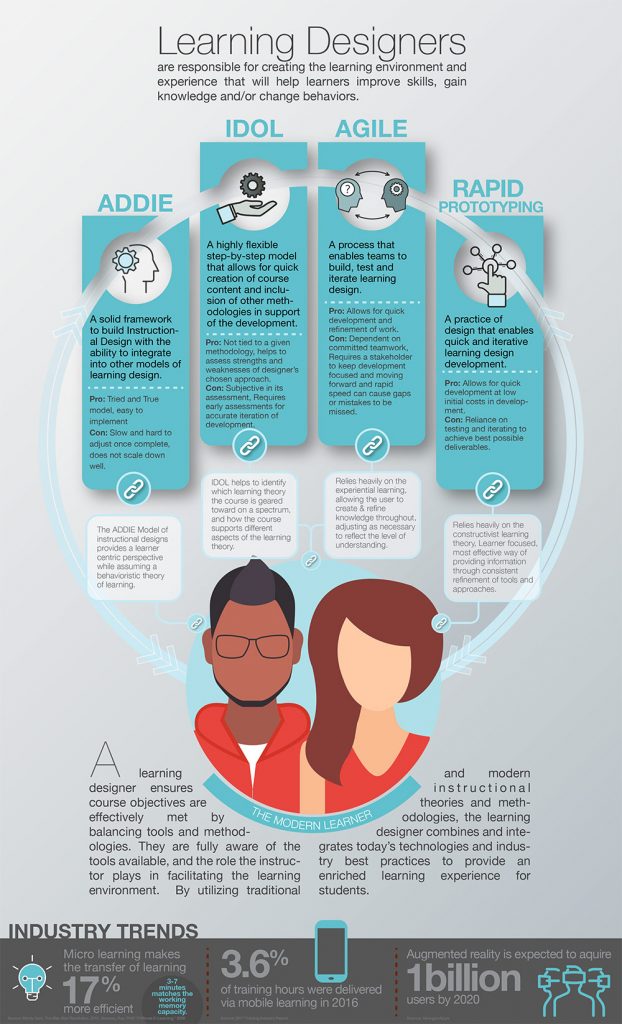
Agile Design Methodology allows for courses to be created,iterated, and improved upon by a cross-functional team in a reduced time frame.Agile teams utilize this framework to take advantage of these dedicated resources in close proximity to iterate on all facets of the content and course development. The agile process allows designers to take better advantage of traditional Instructional methodologies and improve the quality of the outputs in a faster time frame. Agile methodology provides a set of tools and processes that enable rapid development of instructional design.
The speed at which teams work together in Agile methods can result in certain components being missed across all aspects of the development needs. Any gaps in the Agile team and its process can result in deadlines being missed, holes in the content or course and learner objectives not being fully met. Agile methodology requires strong commitment from all team members to provide consistent participation and input in order to develop complete, effective, and accurate courses.
The Agile design methodology provides great benefits in the reduced time and costs associated with traditional course preparation. It provides a framework that allows adjustments during the course to reflect changes in information or technology. During the initial stages of design it can also be created with fewer personnel adding personnel only when needed or beneficial to overall course outcomes. With this building the “plane in flight” method it allows content to be improved during the course so that the learners can benefit from the newest information and technology or techniques. (I caveat this statement while some of the content may be “built inflight” the course and learner outcomes remain stable as the guiding point for the course)
Analysis of how these three models influence, or replace, the traditional design process.
I believe these three models utilize current development practices that are successfully used in other businesses and industries’ to help improve upon the traditional models in order to better serve today’s learners. All three bring about instructional design that is better suited for today’s current learner paradigms and business priorities and limitations. All three, when used in conjunction can help improve instructional design by allowing large cross-functional teams to collaborate on the development and improve the speed at which it’s created, implemented and delivered. Even at speed these methodologies can help ensure courses maintain a high standard of quality and effective learner engagement. The integration of new technologies into everyday lives also provides an expectation from learners that their tools used in their education should keep pace with the outside world; no one wants to conduct online class by dialing in to a mono-chrome BBS to read the latest post, read a review, or watch a video that was seen in a face-to-face class. Failing to keep pace with technology and current trends will create barriers to learning and pull away from the initial intrinsic motivation that a learner came with. While the ADDIE process and other traditional models provide a stable and deliberate process in which a course can be quickly scaled as necessary to meet its intended audience, the drawback is the time required to design and implement them. Which ultimately puts the final course at risk of being obsolete by the time it gets through its first design iteration. These newer models, while implementing the intent and parts of the traditional design models; replace their longer development timelines to produce a more responsive method that is constantly evolving.